
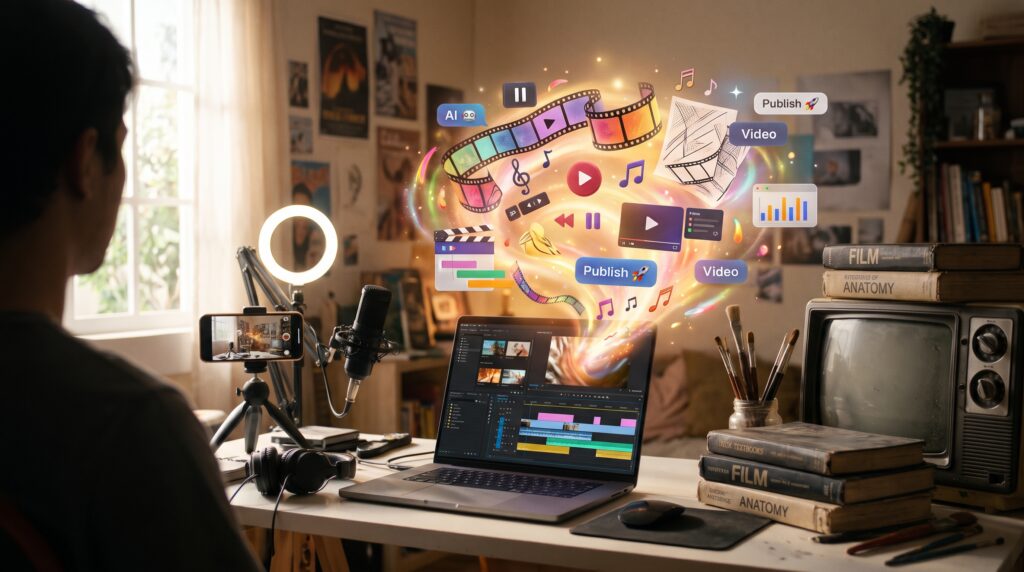
Every few months, a familiar debate erupts across the internet, television studios, and creative circles. Usually, it starts with someone complaining about the state of modern entertainment. A traditional artist, a seasoned critic, or a veteran of the old media establishment points a finger at the new generation of creators, those making short-form videos, digital sketches, indie web series, or experimental music from their bedrooms, and delivers a familiar sermon: “Real art requires years of grueling study, endless sacrifice, and decades of breaking your back before you earn the right to be seen.”
On the surface, this sounds noble. Who could possibly argue against hard work, dedication, and mastery? We are raised on stories of the tortured genius, the classical violinist practicing twelve hours a day until their fingers bleed, or the filmmaker spending twenty years carrying cables on movie sets before being allowed to touch a camera.
Yet, when we look closer at this narrative, especially when it is weaponized to gatekeep modern television, digital video, and artistic expression, something far less noble begins to show through the cracks. Beneath the surface of “protecting the craft,” there is often a quiet, insidious form of resentment. It is the unspoken demand that says: “I had to suffer to get here, so you must suffer even more before you are allowed to take a single step.”
At MYETV, where we have spent over a decade building an open ecosystem for independent television, digital creators, and technological innovation, we believe it is time to challenge this dogma. Art is not a prison sentence, creativity is not a hazing ritual, and modern tools, from smartphones to Artificial Intelligence, are not the enemies of human expression. They are the exact opposite: they are the keys that unlock the doors for millions of people who were previously told they didn’t belong.
The surgeon vs. The storyteller: understanding the difference between high-stakes precision and artistic expression
Before going any further, let us clear up a very common misunderstanding. Critics of modern creative accessibility love to use false equivalencies. They will say, “If you wouldn’t let an untrained amateur fly a commercial airplane or perform open-heart surgery, why should we celebrate someone who hasn’t spent ten years in conservatory or film school?”
The answer is remarkably simple: because a bad video never killed anyone on an operating table.
When we talk about medicine, civil engineering, aviation, or electrical infrastructure, years of rigorous, standardized, and unforgiving study are non-negotiable. If a surgeon makes an impulsive, unstudied cut, a human life is lost. If an architect miscalculates the load-bearing capacity of a bridge, dozens of people are in danger. In these fields, eliminating errors through years of repetitive, disciplined training is a moral and practical necessity. You cannot “improvise” brain surgery, and nobody wants a pilot who relies on “happy accidents” during a thunderstorm.
Art, television, music, and storytelling operate under completely different laws of physics.
Art is not an exact science designed to prevent physical catastrophe; it is a human language designed to provoke emotion, spark curiosity, entertain, comfort, or make someone think. When you apply the rigid, life-or-death standards of medical school to the act of making a video, writing a song, or launching an independent web channel, you fundamentally misunderstand what art is for.
Yet, traditional gatekeepers continue to treat the creative industries as if they were closed guilds with strict apprenticeship quotas. They insist that there is only one valid path: the long, agonizing climb up a ladder that they happen to control. By doing so, they confuse technical endurance with artistic value. They forget that history’s most beloved cultural movements were almost always started by outsiders who didn’t follow the textbook rules.
The hidden envy behind “You have to break your back”
Why do some established professionals get so angry when a young creator, using a simple setup and a fresh idea, manages to captivate an audience without going through twenty years of traditional hardship?
To understand this, we have to talk honestly about human psychology. When someone spends a massive portion of their youth enduring financial instability, rigid academic drills, toxic workplace hierarchies, and constant rejection just to earn a seat at the table, they naturally develop a deep emotional attachment to their own suffering. That suffering becomes their badge of honor. It is how they justify the years they lost.
Then, the world changes. Technology evolves. Suddenly, a twenty-year-old with a laptop, a free editing suite, and an internet connection can reach an audience that used to require a multi-million-dollar broadcast network- [Network of Contents: is the channel in which owners can post their content and the audience can see the contents posted by the owners] - . A creator who spends one or two focused hours a day experimenting with visual ideas can build a loyal community without ever asking permission from a television executive or a record label.
For those who endured the old system, this feels deeply unfair. Instead of celebrating the fact that the next generation doesn’t have to go through the same meat grinder, a defensive reaction kicks in. The narrative shifts from “Look how much easier it is to create now!” to “If you haven’t broken your back like I did, your work isn’t real art.”
This mindset is not just unfair, it is actively dangerous.
When society tells young people that they must grind themselves into dust, repeat the same mechanical exercises until they are numb, and sacrifice their mental and physical health before they are allowed to share their voice, we don’t produce better art. Instead, we produce burnout, anxiety, and silence. Countless brilliant minds give up before they even begin because they are convinced they don’t have the ten spare years or the financial privilege required to “pay their dues.” Some push themselves so hard trying to meet an imaginary standard of perfection that they lose all joy in the very thing they loved, and in the worst cases, they destroy their well-being chasing validation from people who will never be satisfied anyway.
True mentorship never demands that the student suffer as much as the teacher. A good builder invents better tools so the next generation can build higher, faster, and with less physical strain. Only an insecure gatekeeper wants everyone else to carry bricks by hand forever just because they had to.
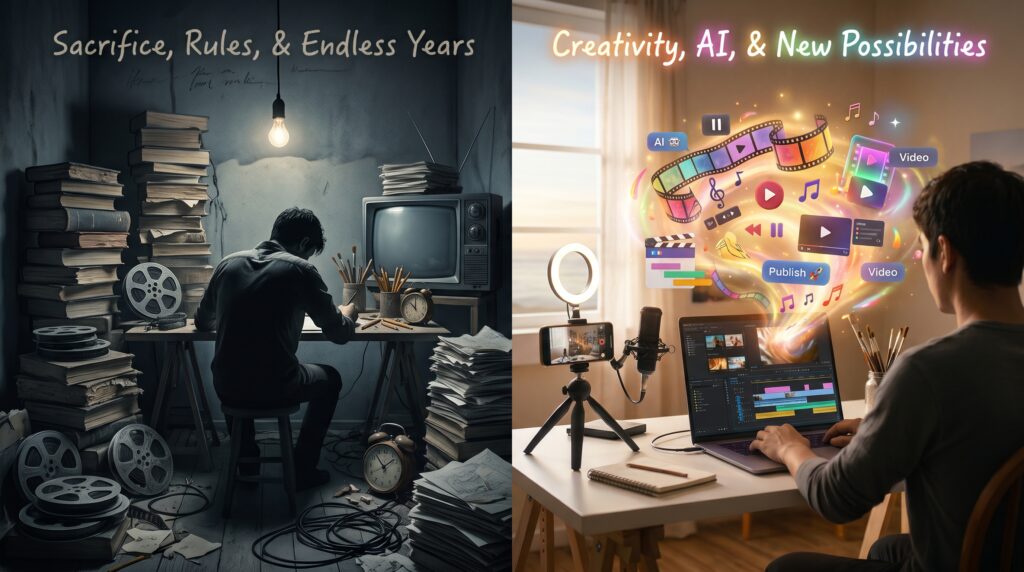
The beauty of imperfection: why “Mistakes” are often the soul of art
Another major flaw in the “years of grueling practice” philosophy is its obsession with flawless execution. Traditional training often focuses on repeating an action thousands of times until every trace of error is eliminated. Play the scale until every note is mathematically even. Edit the scene until every transition follows the textbook rule. Speak with the exact same broadcast cadence as every anchor before you.
The problem? When you remove every single imperfection from a piece of work, you often remove its humanity along with it.
Think about the moments in television, cinema, and music that actually stay with you for years. Are they the sterile, hyper-polished corporate productions where every hair is in place and every line was rehearsed fifty times? Almost never. What we remember, what makes us laugh, cry, or feel an immediate connection, is the raw, unscripted moment:
- In music: yhink of legendary rock and blues recordings where a guitarist’s voice cracks slightly on an emotional lyric, or a drumbeat rushes a fraction of a second during a live take. Sound engineers today could easily “fix” those anomalies with pitch correction and grid alignment, yet doing so would strip the song of its heartbeat.
- In cinema and television: some of the most iconic scenes in film history happened by pure accident. An actor tripped over a prop and stayed in character; a sudden rainstorm ruined the scheduled lighting, forcing the director to shoot in silhouette; a microphone picked up an unexpected laugh from the crew that made the moment feel electric and alive.
- In modern digital video: look at why audiences are increasingly turning away from heavily scripted, over-produced legacy television and flocking to independent creators. Viewers are tired of perfection. They love when a creator leaves in a genuine stumble over a word, an unexpected background noise, a spontaneous reaction, or an unconventional camera angle that a film school professor would mark with a red pen.
In art, an error is not a failure; it is a fingerprint. It is proof that a real human being was present in that moment, making choices in real time rather than executing a pre-programmed routine.
When people are terrified of making mistakes because they believe they aren’t “qualified” yet, they freeze. They spend months planning a single video that never gets uploaded. They write scripts they never record. They sit on ideas that could have brightened someone’s day because they think they need another five years of preparation before they are “ready.”
The truth is that you learn far more by publishing ten imperfect things and seeing how real people react to them than you will ever learn by practicing in isolation for five years trying to achieve mythical perfection.
A world full of shortcuts (and why taking them is smart, not lazy)
There is a strange stigma around the word “shortcut.” In traditional culture, taking a shortcut is equated with cheating, laziness, or cutting corners. Yet, in every other area of human progress, finding a shorter, smarter path to a goal is celebrated as innovation.
Imagine telling a writer today that using a word processor is “cheating” because real authors write with a feather quill by candlelight, or telling a photographer that using autofocus is “lazy” because true artists calculate focal distance manually with a measuring tape. It sounds absurd, yet that is the exact argument people make when they dismiss modern creative workflows.
Today, there are dozens of legitimate, exciting pathways into the artistic and television world that didn’t exist even ten years ago:
- Micro-Storytelling and Short-Form video: you no longer need a 90-minute feature film or a 26-episode television season to tell a compelling story. A 60-second short can deliver a complete emotional arc, a sharp comedic punchline, or a fascinating educational insight. Mastering the art of saying something meaningful in under a minute is a genuine creative skill—one that allows people with busy lives, day jobs, or family responsibilities to participate in culture.
- Modular Creation: you don’t have to do everything from scratch every single time. Modern creators use sound libraries, modular visual templates, open-source tools, and collaborative platforms to assemble their vision. A solo creator working from a small apartment can now run an entire thematic television channel, handling scripting, visuals, sound design, and broadcasting, tasks that used to require a thirty-person production crew.
- Cross-Pollination of skills: maybe you aren’t a trained animator, nor a classical musician, nor a professional cinematographer. Maybe you are someone who simply has a great sense of humor, a knack for explaining complex topics simply, or a unique perspective on everyday life. Modern digital ecosystems allow you to combine your natural strengths with accessible tools to fill in the technical gaps.
Taking a faster road does not diminish the destination. If two travelers want to reach the top of a mountain to admire the view, and one spends three weeks hacking through dense thorny bushes while the other takes a newly built trail in three hours, they both see the exact same sunrise. The view isn’t “less real” for the person who took the trail, they just have more energy left to enjoy it and build something once they arrive.
How artificial intelligence changes the equation: creativity in 1 or 2 hours a day
Nowhere is this shift more dramatic, or more misunderstood, than in the rise of Artificial Intelligence.
Whenever a new creative technology arrives, the reaction from the establishment follows a predictable script. When photography was invented in the 19th century, painters declared it the “death of art.” When synthesizers and drum machines appeared in the 1970s and 80s, traditional musicians insisted that pressing buttons wasn’t “real music.” When digital non-linear editing replaced physical film splicing, veteran editors claimed the craft was ruined.
Today, AI is sitting in that exact same hot seat. And just like before, the loudest criticisms often miss the most transformative reality: AI dramatically lowers the barrier between having an idea and bringing it to life.
Think about what used to stop an ordinary person from creating audiovisual art:
- You had a brilliant concept for a sci-fi short story, a historical documentary, or a satirical comedy sketch, but you didn’t have $50,000 to hire actors, rent studio space, buy cinema cameras, and pay a post-production house.
- You had a full-time job, bills to pay, and responsibilities, leaving you with only one or two hours a day of free time, nowhere near enough to spend six months hand-drawing animations or learning complex 3D rendering software- [Program/Software: the instructions that control what a computer does; computer programs] - from zero.
With today’s AI-assisted workflows, combined with lightweight editing and independent broadcasting platforms, that entire equation flips upside down.
In one or two focused hours a day, a single person can now:
- Brainstorm and refine a narrative concept, bouncing ideas back and forth until the structure clicks.
- Generate custom visual assets, backgrounds, storyboards, or atmospheric music tailored to the exact mood of their story.
- Assemble a crisp, engaging short video or episodic show, add subtitles or voiceovers in multiple languages, and publish it to a global audience before dinner.
Does AI replace human taste, humor, empathy, or vision? Not at all. If you give ten people the exact same AI tools, nine of them might produce forgettable noise, while the tenth person, the one with a distinct point of view, a sharp sense of timing, and an authentic emotional core, will create something unforgettable.
AI does not eliminate the artist; it eliminates the drudgery. It removes the mechanical bottlenecks that used to force creators to spend 90% of their time on tedious technical labor and only 10% on actual imagination. Now, you can spend 90% of your energy on what you want to say and how you want people to feel, while the tools help you handle the heavy lifting.
For someone who only has an hour after work, or a student balancing classes, or a parent raising kids, this isn’t “cheating.” It is liberation. It means art is no longer the exclusive playground of people who have unlimited free time, wealthy parents, or institutional backing.
Redefining television and culture for everyone
Why does this philosophy matter so much to us at MYETV?
When traditional television was born in the twentieth century, it was built on scarcity. There were only a handful of frequencies available, broadcasting equipment cost millions, and a tiny circle of executives decided what millions of people were allowed to watch every evening. That scarcity naturally bred elitism. If only fifty shows could air across an entire country, gatekeepers had to invent strict rules to keep almost everyone out.
The internet shattered that scarcity, and modern independent platforms are finishing the job. Television is no longer a one-way box sitting in the corner of the living room controlled by a few giant corporations. Today, television is an open canvas. Anyone can launch a channel, curate a thematic stream, experiment with formats, mix live broadcasts with on-demand shorts, and build a direct relationship with viewers around the world.
If we carry the old, elitist mindset of “you must suffer for ten years before you are worthy” into this new era, we waste the greatest creative opportunity in human history.
We shouldn’t be asking creators:
- “Where did you go to school?”
- “How many years did you spend as an unpaid assistant?”
- “Did you follow every classical rule of composition?”
Instead, we should be asking:
- “Does this make me feel something?”
- “Did this make me laugh, think, or see the world from a slightly different angle?”
- “Is there a genuine human spark behind this?”
A message to anyone holding back: start where you are, with what you have
If you are reading this and you have been sitting on an idea, whether it is a video series, a short documentary, a comedy channel, a musical experiment, or a visual blog, take this as your permission slip to ignore the gatekeepers.
You do not need to wait until you have mastered every technical manual. You do not need to sacrifice your health, your sleep, or your sanity on the altar of “paying your dues.” You do not need to apologize for using smart tools, modern shortcuts, or Artificial Intelligence to turn a one-hour daily session into something real and shareable.
Embrace your rough edges. Leave in the moments that feel human. Let your early videos be a little messy, experimental, and unpolished, because that raw energy is often the very thing that makes people stop scrolling and pay attention.
Art belongs to the curious, the playful, and the brave, not to those who suffered the longest. Pick up the tools in front of you, spend an hour creating something today, and put it out into the world. You might be surprised by how many people were waiting to see exactly what you have to offer.
